© OpenStreetMap contributors Protomaps
 MineCart
Stop guessing
what to bid.
Bid too high, lose the load. Bid too low, lose your margin. MineCart finds the balance for every spot load, with your costs, market rates, and win chance in one place.
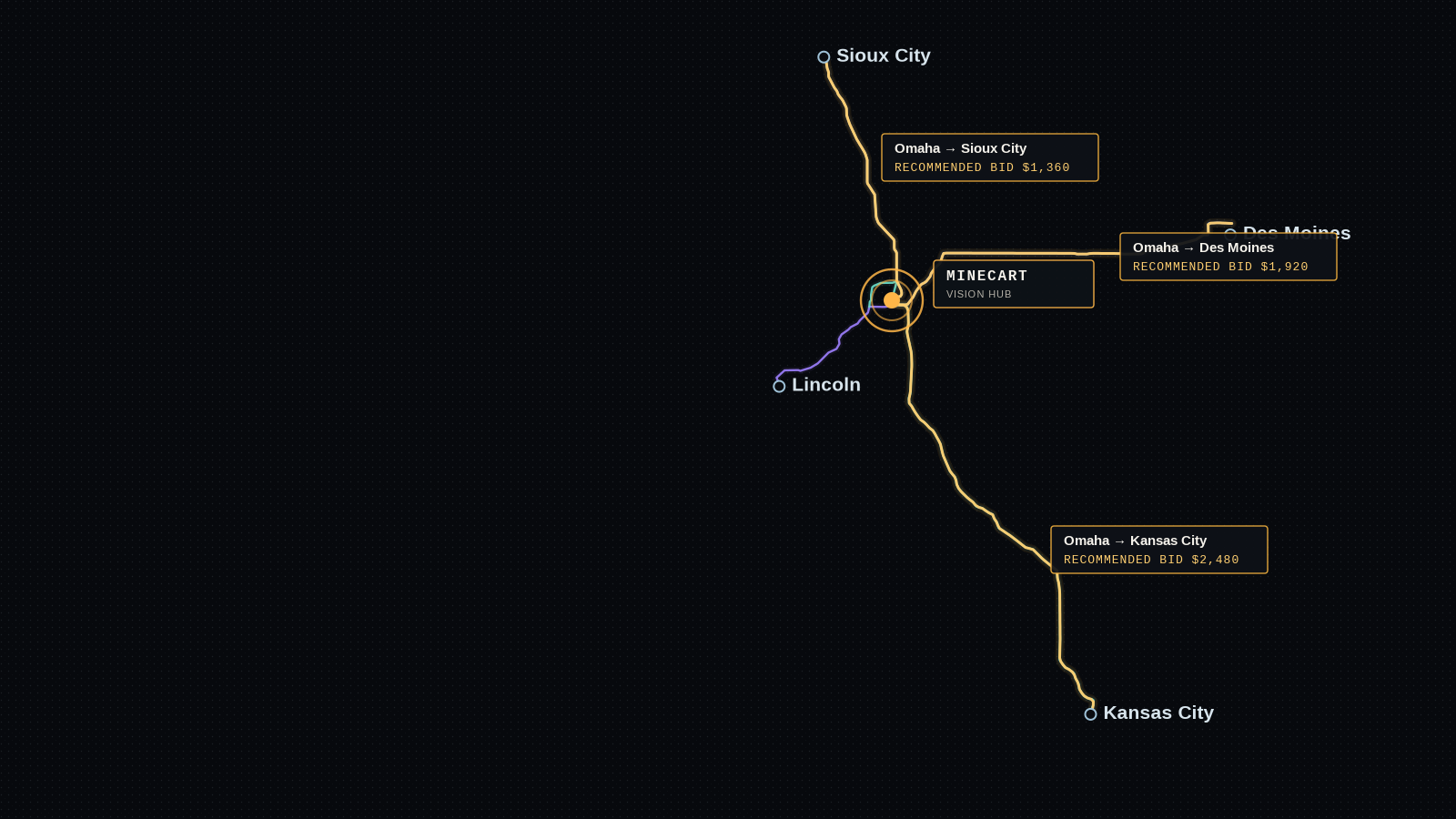
An illustrative animation shows weather, freight-market, load, rate, and fleet signals converging on a MineCart decision hub. An inference sequence produces three recommended bids before the scene repeats. Sample scored loads follow below.
Free to sign up. 10 lane prices a day on the Free plan.
What would you bid on this load?
A lane average only tells part of the story. This sample shows how MineCart weighs your costs and chance of winning to recommend a bid: the price that balances winning the load with earning a margin.
- Load to bid St. Louis → Denver890 mi
- Lane spot rate $2,425$2.72/mi
- Spot rate, last 30 days −5.5%
- Reverse lane rate $1.72/miDenver → St. Louis
- Spot rate confidence High
- Tender rejections, St. Louis 6.2%
- Tender rejections, Denver 4.6%
- Fuel surcharge $0.54/mi
- Your cost to serve $1,930$2.17/mi
- Your bids on this lane 9 of 22 won
- Your win rate, this lane 40%
- Win rate with this broker 48%
MineCart
Recommended bid $2,370
Expected profit at every bid
← Bid lower: win more, earn lessBid higher: earn more, win less →
Want this on your next bid?
Start with 10 lane prices a day.
MineCart shows its work
Most rate tools hand you a single number, but MineCart shows you all the possibilities based on your data. Below is a sample day of MineCart bids: open any load and drag the sliders to see how price moves its win chance, where expected profit peaks, and which inputs drove the bid.
| Lane | Miles | Win chance | Recommended bid | Expected profit |
|---|---|---|---|---|
| St. Louis → Denver | 890 | 41% | $2,370 | $178 |
| Lincoln → Columbus | 810 | 28% | $2,365 | $138 |
| Denver → Sioux City | 544 | 42% | $1,240 | $131 |
Showing 3 of 2,847 scored loads. Illustrative sample run: lanes, costs, and prices are synthetic, not customer data.
How MineCart prices a load, and who builds it
The three numbers behind every bid
Every bid is a trade between margin and the chance of winning. MineCart weighs it with three numbers for each load, and recommends the price where they balance best.
-
01
Cost to serve
What it costs your team to haul the load. A bid below it loses money even when you win.
-
02
Win chance
How likely you are to win the load at each price. It falls as the price rises; MineCart models how fast from the latest market rates, lane signals, and your own bid history.
-
03
Expected profit
Win chance × (bid − cost to serve). The best bid is where this peaks: high enough to earn a margin, low enough to still win.
How MineCart recommends a bid, step by step
Each day MineCart combines the latest load boards and market rates with your own bid history and costs, so each recommendation reflects your network, not just the market average.
-
01
Gather daily inputs
Pull in the day's loads, the latest market rates, your bid history, and your cost to serve.
-
02
Model each lane
Predict how each price moves the win probability of each load, lane by lane.
-
03
Price every load
Recommend the bid that maximizes expected profit, tuned to your target win rate and lane context. When the data can't support a confident price, MineCart says so instead of guessing.
-
04
Deliver and review
See recommendations per lane in the MineCart app, pull them through an API, or download them as a workbook, and keep run history to track win rate and margin over time. Operators still choose what to bid.
How your team stays in control
- Human control Operators can review every recommendation, decide what to submit, and drive MineCart to fit their strategic goals.
- Transparent pricing Every recommended bid shows the win curve, the margin, and the inputs behind it. Inputs, model versions, and deliverables stay connected for every run.
- Recoverable processing Versioned artifacts and durable records support repeatable daily operations.
Who builds MineCart
MineCart is built by Aulendur Labs, a deep tech research company in Omaha, Nebraska, founded in 2024 by Aaron Parker (CEO) and Jorden Gershenson (CTO). The same team builds DeepLoom, a cross-domain AI forecasting model, and pricing real freight every day shapes how DeepLoom will model market risk.
Before you sign up
What's free, how MineCart prices a load, what data it uses, and where your team stays in control.
Is it free to sign up for MineCart?
Yes. Creating a MineCart account is free, and the Free plan includes 10 lane prices a day. The Paid plan is $10 a month for up to 50 lane prices a day.
What is MineCart?
MineCart is freight pricing intelligence from Aulendur Labs. It recommends a bid for each spot-market truckload load your team is considering, using the latest market rates, your own costs, and your bid history, and it shows the win probability and expected profit behind every recommendation. Operators review the recommendations and decide what to submit.
How does MineCart choose a recommended bid?
For each load, MineCart models how the chance of winning falls as the price rises, then weighs that win probability against the profit the load would earn at each price. The recommended bid is the price with the highest expected profit inside the range the model supports.
What is a good bid on a truckload load?
A good bid wins the load and still earns a margin. Bid too high and you lose the load; bid too low and you give away margin, or haul at a loss. The best bid balances the two: it is the price where the chance of winning times the profit if you win is highest. MineCart calls that the expected-profit peak and recommends it for every load.
How do you calculate expected profit on a freight bid?
Expected profit is the win chance at a price times the profit if you win at that price: win chance × (bid − cost to serve). A $1,800 bid on a load that costs $1,500 to serve, with a 40% chance of winning, has an expected profit of 0.4 × $300 = $120. MineCart works this out at every price in the range its model supports and recommends the highest.
What is win probability in freight bidding?
Win probability is the chance a bid wins the load at a given price. It falls as the price rises. MineCart estimates it for each load from the latest market rates, lane signals such as tender rejections and spot-rate trends, and your own history of bids and outcomes.
What data does MineCart use?
Each day MineCart combines the loads available to bid, market rate and tender data for each lane, your history of bids and outcomes, and your cost to serve each load. Lane signals such as tender rejections and spot-rate trends feed the win-probability model.
How is MineCart different from a rate benchmark or lane average?
A benchmark gives one market number for a lane. MineCart prices the specific load for your business: it accounts for your costs and your win history, shows how each price changes the win chance, and lists the inputs that drove the bid. When the data cannot support a confident price, it says so instead of guessing.
Does MineCart replace our pricing team?
No. MineCart is decision support. It prepares a recommended bid for every load so your team spends its time on judgment calls rather than manual pricing. Operators review every recommendation and choose what to submit, and run history keeps outcomes easy to review.
Who is MineCart for?
Truckload carriers of every size that bid on spot loads, from an owner-operator pricing a few loads a day to a large fleet's pricing team running every load through MineCart. Owner-operators and small fleets can start on the free tier; large fleets talk to the team about Enterprise.
Does MineCart price spot bids or contract bids?
Spot bids. MineCart recommends a price for each truckload load available to bid on the spot market. It does not price contract or RFP bids.
How does MineCart deliver recommendations?
Three ways: per lane in the MineCart app, through an API, or as a downloadable workbook. Every recommended bid shows the win curve, the margin, and the inputs behind it, and run history keeps win rate and margin easy to track over time.
Does MineCart integrate with a TMS?
No. MineCart does not integrate with a transportation management system. Recommendations are presented per lane in the MineCart app, through an API, or as a downloadable workbook, and run history keeps every run available to review.
What does MineCart do with my data?
On the Free and Paid plans, MineCart uses your loads, costs, and bid outcomes to price your bids, and uses them anonymized, without your name, company, or contact details, to improve its models. Enterprise data serves that customer as its agreement sets out and is never shared with another customer. Aulendur does not sell personal information. The MineCart Privacy Policy has the details.
How much does MineCart cost?
MineCart is free for 10 lane prices a day, with email automation and credits for reporting whether your bids won or lost. The Paid tier is $10 a month for up to 50 lane prices a day. Enterprise, for large fleets that price every load, is priced with the team: email [email protected].
Where is MineCart built?
In Omaha, Nebraska. MineCart is built by Aulendur Labs, a deep tech research company that also builds DeepLoom, a cross-domain AI forecasting model. MineCart is live with customers, and Werner Enterprises is a partner.